



The promise
It is hard to talk about British Columbia’s festival history without Shambhala entering the room. Shambhala has the mythology: the long-running farm, the return-year ritual, the giant reputation in Canadian electronic music. Shambhala is the obvious reference point, and an easy comparison quickly turns lazy.
Bass Coast sits close enough to that conversation to be mentioned beside it, but the stronger story is not rivalry. What does Bass Coast offer when size is not the objective?
The origin helps answer that. Bass Coast began in 2009 in Squamish and later moved to Merritt in 2013, which gave the festival room to become the more settled BC festival people know now. Founded and led by Liz Thomson and Andrea Graham, it grew as an independent, artist-owned festival rather than a faceless expansion brand. That is part of the way Bass Coast talks about itself: design, sound, art, harm reduction, consent, community, and detail are not side dishes. They are part of the founding promise.


The Merritt chapter is especially important. A festival changes when it finds a repeatable home. Stages can develop character. Arrival patterns become known. The audience starts building rituals around the site. Artists, vendors, workshop facilitators, and returning attendees begin to understand the same map. Bass Coast’s history is short compared with older North American giants, but eighteen years is long enough to prove that the boutique scale is not a phase. The format matters.
That scale is part of the gravity. Bass Coast is limited-capacity by design, and the 2026 research points toward a festival thinking carefully about how size, vendors, stages, and site experience fit together. An unconfirmed capacity number adds nothing. The practical point is simpler: Bass Coast’s intimacy is not accidental. That rule helps the festival protect what it has built.
Where the promise meets the ground
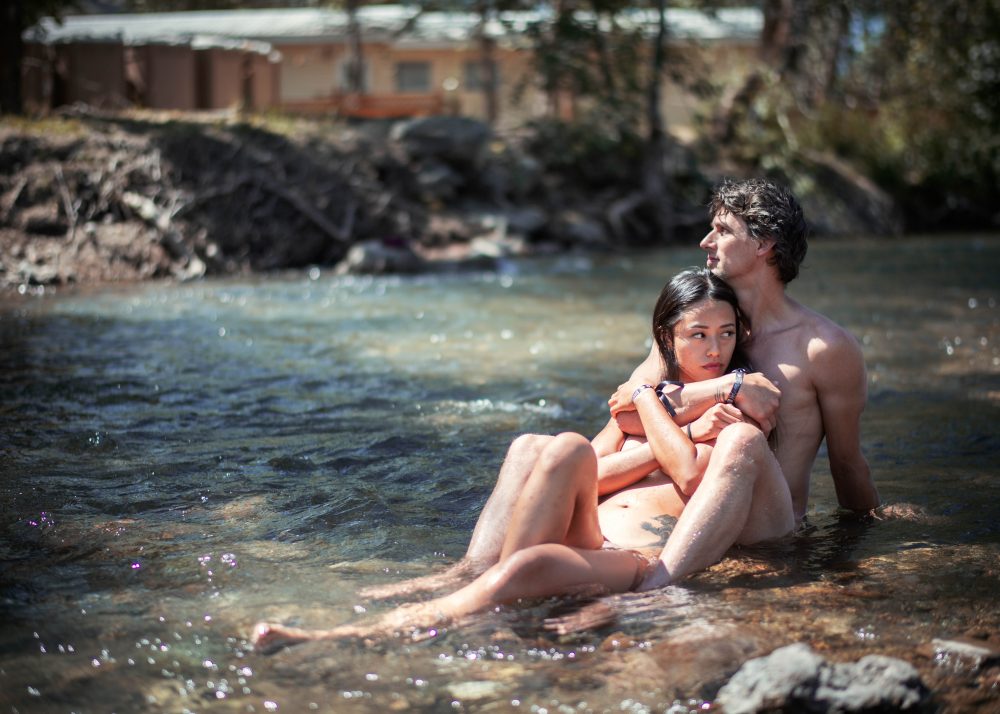
That is a different kind of ambition. At a mega-festival, size becomes part of the spectacle: the distance between stages, the crowd mass, the scale of the infrastructure, the feeling that you have entered a temporary city. Its appeal works through detail rather than sheer size. It asks what happens when the details have more room to breathe: the stage environments, the art people stop to photograph, the workshops that interrupt a party weekend with an idea, the way people move from river to dancefloor to camp and back again.
The details earn attention. A good camping festival is never only a lineup. It is weather, rules, rituals, costumes, bottlenecks, sleep deprivation, food choices, water strategy, tiny acts of care, and the social permission to become a brighter version of yourself for a few days. Music is the engine, but the life around the music is what decides whether the weekend stays with you.
Bass Coast seems to understand that belonging is built, not wished into existence. Its public identity leans hard into independence, art, consent, harm reduction, cultural respect, land acknowledgement, and local care. Those words are easy to print and harder to live up to, which is why they are worth watching closely. Policies do not prove that every attendee has the same experience. They do show what the festival believes belongs inside the frame.
Harm reduction is one of the clearest examples. The festival presents care as operating infrastructure rather than decoration. Substance checking, education, consent practice, and safety language are part of the way the festival presents itself. Across North American festivals where some events still treat the reality of risk as something to hide from liability, that visibility matters. It does not make a festival risk-free. It makes the conversation more honest.
The same is true of the festival’s cultural-respect work. Bass Coast publicly documents its headdress ban, equity commitments, regional work, and representation standards. Again, this is not about handing out a perfect score from a distance. Bass Coast has tried to define a festival as something more than sound and scenery. The values are part of the architecture.
Why the story still holds
That does not mean Bass Coast gets flattened into a glowing postcard. Public attendee discussions still circle the practical realities of the place: heat, dust, wind, long walks, camp setup, generators, price, and the way a festival changes as it grows older and more visible. Some of that is ordinary camping-festival friction. The rest rewards preparation. A festival with no friction is usually a marketing fantasy. A festival with care, identity and friction deserves examination.
Its clearest identity appears where music becomes visual, social, physical and practical. Bass Coast becomes legible in how a weekend is designed, how a crowd gathers, how a site teaches people to move through it, and how a festival decides what kind of temporary society it wants to build.
Bass Coast does not need to become the next Shambhala.
Its future depends on whether Bass Coast can show another way for BC’s independent festival scene to hold its ground: smaller in scale, careful in design, serious about belonging, and confident enough to have its own gravity.
The 2026 Deep Blue theme gives Bass Coast a strong surface, but the deeper identity sits below it. Bass Coast’s site is built from connected habitats: sound-system rooms, riverside decompression, interactive art, murals, workshop brains, movement spaces, vendors, and site-wide rules. The festival is designing a social environment at a scale where design can still be felt.
Continue Exploring
 Canada
Bass Coast Sound Guide
A listener-first route through Bass Coast 2026, from house and low-end pressure to turntablism, funk, melody and regional discovery.
Canada
Bass Coast Sound Guide
A listener-first route through Bass Coast 2026, from house and low-end pressure to turntablism, funk, melody and regional discovery.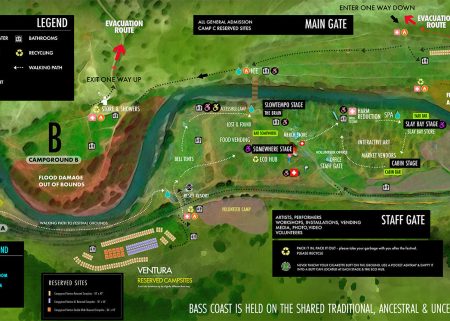 Canada
Bass Coast Survival Guide
Practical Bass Coast 2026 preparation for heat, cold nights, dust, river time, camp setup, transport, food, footwear and official rules.
Canada
Bass Coast Survival Guide
Practical Bass Coast 2026 preparation for heat, cold nights, dust, river time, camp setup, transport, food, footwear and official rules.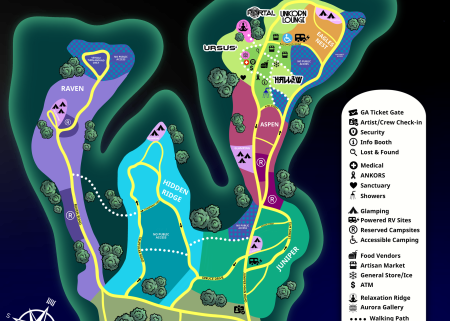 Wicked Woods ’26 Survival Guide
Plan Wicked Woods 2026 around vehicle passes, gate hours, uneven terrain, weather, offline maps, care routes, water, sleep and a festival-specific checklist.
Wicked Woods ’26 Survival Guide
Plan Wicked Woods 2026 around vehicle passes, gate hours, uneven terrain, weather, offline maps, care routes, water, sleep and a festival-specific checklist.