



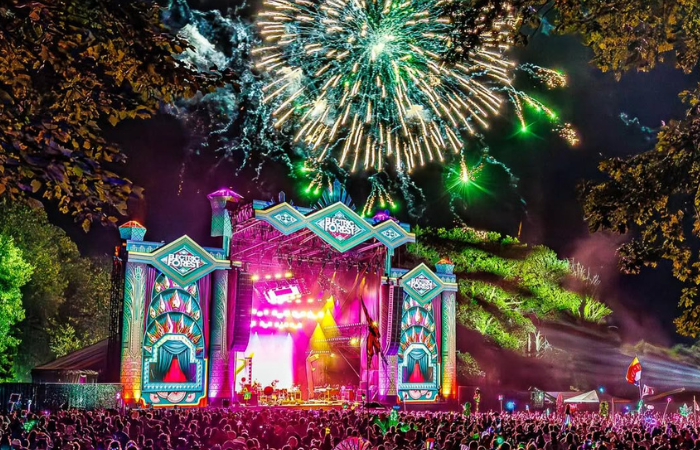
The promise
Some festivals are built around the stage. The walk between stages organizes Electric Forest.
The Forest did not appear out of nowhere. Rothbury, Michigan, and the Double JJ Resort already had festival history before Electric Forest took its current shape. The Rothbury Festival years in 2008 and 2009 proved that the property could hold a large camping-music world, and the 2011 debut of Electric Forest shifted that site toward a more electronic, participatory and art-forward identity. That transition begins the modern Forest story: the festival changed its name and asked more of the environment, its audience and the journey between stages.
Sherwood Forest became the difference. Plenty of festivals have trees near them. Electric Forest turned the woods into a central character: hammocks, art, lights, performers, secret corners, paths that slow people down, and a social mythology built around wandering. That history explains why the festival has a loyalty culture. People return to a site that trained them to get lost on purpose.


That is the secret hiding in plain sight. The lineup can pull the crowd: GRiZ, ILLENIUM, Excision, Chris Lake, Kaskade, The String Cheese Incident, Madeon, LSDREAM, Ganja White Night, Sammy Virji, Channel Tres, Bob Moses, and more. But the festival’s deeper identity lies in what the site does to people while they are moving.
Sherwood Forest is the centre of that idea. A normal festival path gets you from one stage to another as efficiently as possible. Electric Forest makes the path part of the event. By day, it offers hammocks, art, hidden corners, and places to drift. By night, the same space becomes a lit environment full of installations, performers, characters, surprises, and the feeling that the festival is responding to your curiosity.
Where the promise meets the ground
A well-designed festival can change how people behave toward place and one another by rewarding care, curiosity, cooperation, patience and active participation. They make adults play. They make strangers talk. They make costumes feel normal. They make a walk feel like an invitation. They turn a crowd from an audience into a temporary culture.
Electric Forest’s strength is that it understands environment as programming. The Forest is not decoration around the lineup. It is a stage without one fixed performer. Participatory art, roaming characters, Plug In Programs, the Brainery, campground markets, Main Street, Camp Traction-style care paths, and the long-running Forest Family identity all rely on attendees to activate the festival.
There is also a real tension here. Scale remains part of the bargain. A festival this big can become exhausting, crowded, dusty, expensive, and logistically demanding. The same wandering that creates discovery can also create sore feet, missed sets, and the need for a better water plan. That does not cancel the beauty. It makes preparation part of the experience.
A harder civic story sits underneath the fantasy. Electric Forest has become important enough to Rothbury that permits, attendance allowances, ticket surcharges, local road impact, and resident access are part of the real background. That does not turn Electric Forest into a takedown. It is enough to say the fantasy forest is also municipal infrastructure: beautiful, profitable, burdensome, beloved, and negotiated year after year.
That civic layer changes the stakes. Roads, resident access, permit limits and site restoration determine whether the Forest can return without treating Rothbury as disposable scenery. The fantasy works only when the host community and physical site can absorb the event.
Why the story still holds
That tension is what makes Electric Forest compelling. The festival combines a major entertainment operation with fan-authored ritual, environmental memory and participatory art. It is both a major entertainment operation and one of the few large U.S. festivals that still foregrounds fan-authored ritual, environmental memory, grief spaces, absurdity, and participatory art so visibly.
The familiar praise explains very little. That word gets tired quickly. Electric Forest has found a way to make environment behave like programming. The trees, paths, lights, chapel parties, hammocks, memorial rituals, and strange little encounters are part of how the festival teaches people to pay attention.
Electric Forest matters because it makes the cultural case for why camping festivals still matter. A city concert can give you a good set. A real camping festival can give you a world to live in for a few days.
Electric Forest’s world is built from light, trees, bass, costumes, workshops, camp life, art, and the feeling that something interesting might be around the next corner. Electric Forest matters both as an electronic festival and as a living argument for why site design, culture, and participation change the meaning of the music.
Electric Forest is built for wandering. You are not there to see everything. You are there to become the kind of person who notices more.
Up Next
Continue Exploring
 Electric Forest Sound GuideA listening map for Electric Forest 2026 across bass, house, jam, melodic electronic, indie crossover and the paths between stages.
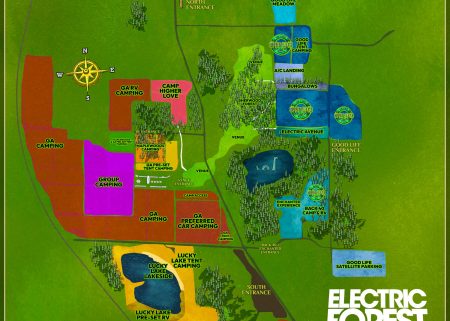 Electric Forest Survival GuideElectric Forest 2026 preparation for walking, weather, dust, camp systems, water, footwear, group navigation, rest and official rules.
 Sonic Springs Survival GuidePrepare for forest camping, cool damp nights, weak signal, river rules, limited showers and the offline planning that makes Sonic Springs easier.